More than 50 percent of women over the age of 50, and 25 percent of senior men will suffer a fracture during their lifetime, due to the effects of osteoporosis. You can treat the culprit, a decrease in bone density, with increased intake of calcium, as well as weight-bearing exercises. The best bone health exercises will increase your bone density.
Use your body’s weight or simple hand weights to increase bone density.
Stand-up/Sit-down
Simply getting out of a chair, then sitting back down will create the muscle/bone interaction that helps increase bone density. You’ll need to do this more than once, and as part of a group of bone health exercises that works leg, arm, shoulder and hip muscles and bones. Stand up and sit down 15 times before moving to your next exercise.
Calf Raises
Stand arm’s length behind a chair and place your hands on the back of the chair. Slowly raise your heels off the floor, hold for two seconds, then lower yourself. You should feel your calf muscle, located on the back of your lower leg, stretching as you move up. Perform 15 repetitions.
Biceps Curls
Using dumbbells, resistance bands or weights as simple as gallon jugs filled with water, start with your arms straight down at your sides, holding your weights with your palms facing forward. Raise your hands to your shoulders by bending your arms in at the elbows, hold for two seconds, then slowly lower, using your muscles to lower the weights, not gravity. Vary the exercise by raising your hands across your body, alternating curls.
Pushups
You can make push-ups easier by doing them on your knees and varying your hand placement, using placements that are best for you. Keep your torso straight as you go down and up. Even if you can’t go all the way down, lowering yourself to a point that takes effort for you will provide some resistance and benefit. If you can’t do 10 or more push-ups, perform as many repetitions as you can, increasing the number each week as you build strength.
Triceps Extensions
You can perform these bone health exercises sitting down or standing up. Using weights that you can comfortably manage, lift the weights into position behind your head, with your elbow pointing up. Your palm should be pointing toward your body, about even between your shoulder blades.
Raise your hands over your head, turning your arms outward so your palms are facing away from you, and you can see the backs of your hands. Repeat 10 to 15 times. You can alternate arms as you do your repetitions.
Dumbbell Exercises
Using dumbbells is an excellent way to improve upper body bones, since these lighter, easy-to-manipulate weights let you exercise while you control your balance. You can use dumbbells standing, sitting on a couch or chair, or lying on the floor.
Raising these weights out to your side, above your head, behind your back and in front of your chest allow you to work a wide variety of muscles, which improves bone density by gently pulling the muscle away from the bone, according to Bone Builders. Experiment with different hand positions, such as your palms facing away from you, toward the floor and toward you, to vary the exercises using otherwise similar moves.
Start with lighter weights, like 2 or 3 lb. dumbbells, and complete five repetitions before you change exercises. As you build muscles, do 10 repetitions. As that become easier, add weight, rather than repetitions.
Resistance Band Exercises
Resistance bands, or cords, are long rubber band-like exercise devices that become harder to pull as you stretch them. Like dumbbells, they are easy to manipulate and control, decreasing worry about losing your balance. The benefits of resistance bands is that they won’t hurt you if you drop them and you can increase resistance by “twirling” them around your hands more before you start an exercise, saving you money on additional dumbbell sets.
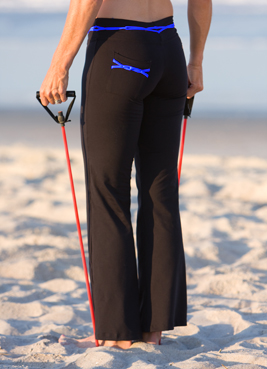
You can do many of the same exercises with resistance bands that you can do with dumbbells, but you can add leg exercises. From a standing position, raise your knee up while holding on to a chair with one hand, then press down against the resistance of the band until your foot touches the floor.
To do this from a seated position, bring your knee up and push your leg forward, away from you. For another leg exercise, from the standing position, move the leg sideways, away from your body, against the resistance of the band, then slowly bring it back.
Bodyweight Exercises
You can also use your body’s weight to perform helpful exercises, depending on your ability to keep your balance. To do push-ups, start from a kneeling position, experimenting with hand placement to make the exercise easier as you begin your workout program.

Standing with both hands on the back of a chair, raise yourself slowly on your toes, stretching your calf muscle at the lower back of your leg. Hold for one or two seconds, then slowly lower yourself. Repeat 5 to 10 times.
Bone Health & Osteoporosis Foundation: What Women Need to Know